
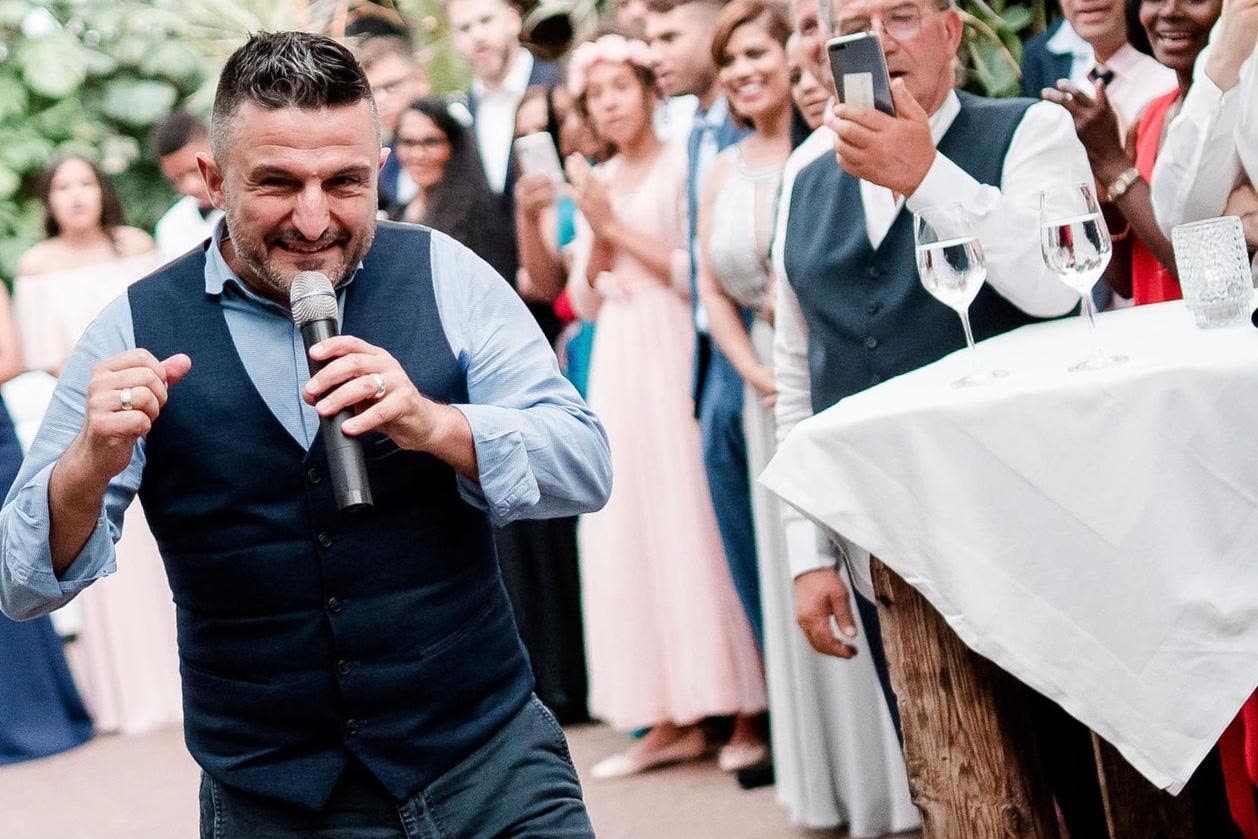
A celebration does not automatically become inclusive simply because the welcomes are translated. Language, music and the programme serve different purposes. Organisational information must be understood reliably, personal contributions may retain their original language and music can create shared moments without flattening cultural differences.
German, Italian and French are the core languages; English is fully available by prior arrangement. Announcements, hosting and included live vocals are agreed personally for international weddings, corporate events and private celebrations.
1. Create a language map for the event
Record which languages are spoken by the couple or host, close family members, company, venue and larger groups of guests. This is not about exact statistics; it is about who needs to understand which information and which language carries personal meaning.
Distinguish between preparation, formal announcements and spontaneous interaction. Antonio conducts the conversation in German, Italian or French; English is available by prior arrangement. Hosting duties are agreed in advance.
Also collect names, forms of address and individual terms whose pronunciation matters. This may include family names, roles, locations or traditional programme elements. A short phonetic note or voice recording avoids misunderstandings and gives everyone confidence without burdening the programme with lengthy translations.
- Language of the hosts
- Languages spoken by larger groups of guests
- Language used by the venue and suppliers
- Translation requirements for essential information
2. Do not repeat every statement in full
Complete translations can quickly double the length of a programme element. Decide which information is essential for everyone. Safety and schedule notices require clarity; for a personal speech, a concise summary may be enough if that is what the hosts want.
Write names, roles and difficult pronunciations into the timeline. Also decide who translates and who has authority if something changes at short notice. If Antonio is to make announcements, the text, language, timing and hosting scope are agreed in advance.
3. Plan musical bridges instead of country blocks
A celebration does not need to work through every heritage in a separate block of music. First collect tracks that have genuine meaning for families, teams or groups of friends. Add styles familiar to several groups and mark songs that belong only to a particular ritual or moment.
Oldies, pop and club hits, hip-hop and R&B, Latin, electronic music, rock, Swiss-German music and Schlager can give the music conversation an initial structure. The styles and tracks Antonio plans for the occasion are established from the audience and personal preferences.
4. Describe traditions and live vocals precisely
If a song accompanies an entrance, family dance or tradition, explain its function in the brief. The DJ needs to know whether an exact version, specific starting point or announcement is required. The people who cue the moment also belong in the timeline.
Antonio performs as both DJ and singer; a live rendition of a tarantella can also give space to his Italian-influenced signature. The hosts discuss directly with him whether this or another live moment suits the event. Number, duration and technical delivery are agreed in advance.
5. Gather music requests in a structured way
With several families or national groups, an open request list can become very long. Give each important group the opportunity to name a small number of priority tracks. Also ask for songs that should not be played or that only fit a particular context.
Combine the answers in one list with a priority and reason for inclusion. This gives the DJ direction while preserving flexibility in the room. A request is not automatically a firm promise; essential tracks are expressly agreed as such.
6. Make language visible in the timeline
For every programme element, add the language and responsible person. One entry might state that the welcome will be delivered in German followed by a brief Italian summary. Microphone handovers and any required music are also recorded there.
Share this document with the venue, hosts, any separate master of ceremonies and the DJ. Changes go through a designated contact person. This prevents spontaneous translation requests that have not been prepared in time or language.
Run through the most important transitions aloud once. This quickly reveals a missing name, a translation that is too long or an unclear microphone handover. The exercise does not require a staged rehearsal; it simply allows language, music and changes of speaker to flow naturally at the event.
7. Safeguard intelligibility through the technical setup
Multilingual content needs not only good wording but intelligible sound. Clarify microphones, speaker positions, room acoustics and soundcheck. Speeches should not compete with background music or service noise. In separate rooms, establish where each piece of information needs to be heard.
DJ Cardillo has his own sound and lighting equipment for events of up to 300 people. His own setup, suitable microphones, lighting and parallel setups are included in the DJ package and checked for the actual room. Only clearly externally sourced specialist equipment is quoted separately.